How to Improve Workplace Safety with Coaching
Improving workplace safety cuts risks, increases productivity, and supports a stronger “triple bottom line” for people, profit and planet.

Companies don’t succeed just by following rules; they succeed by building good habits.
Research shows that when organizations improve their safety habits, the positive changes spread throughout the entire culture.

Performance Consultants has been pioneering a coaching approach to Safety leadership since its start in the 1980s. Working with industrial giants such as Linde Engineering to train thousands of employees in HSE and beyond, we proved that when leaders and teams build strong coaching skills, safety performance gets better, communication improves, and business results follow.
Another great example is Paul O’Neill’s famed approach to safety at Alcoa when he became its “Safety focused CEO” (1987- 1999). When he made safety the main drive, it led to more open communication, better problem-solving, and stronger teamwork at every level as well as commercial success.
More recently, Amy Edmonson, Harvard Business School professor conceptualized and popularised the idea of psychological Safety in her book “Right Kind of Wrong: Why learning to fail can teach us to thrive” and subsequent work. Prof. Edmonson notes that taking an instructional approach may successfully fix a single situation and treat the symptoms of an unsafe action – but coaching is more likely to lead to a long lasting cure through behaviour change.
The results were impressive: operations became safer, people felt more empowered, and profits increased significantly.
Why Coaching Improves Safety
Coaching helps build two key qualities needed for safe performance:
- Awareness of ourselves, others, and the situation
- Responsibility, which means taking ownership of actions and their consequences
Sir John Whitmore said that awareness brings clarity, and responsibility leads to better choices. Together, these qualities help people make decisions that keep themselves and others safe. Coaching turns safety from just a set of rules into a shared way of thinking.
A Proven Approach: Linde Engineering
Performance Consultants works closely with Linde Engineering to embed a Coaching Style of Management that strengthens behavioural safety.
The traditional approach of teaching safety through compliance training reduced accidents, but it didn’t lead to a big drop in fatal incidents. Linde Engineering saw that the next step needed to focus on behaviour.
Together, we introduced a new way of working:
- Leaders involve teams by asking better questions, not just giving instructions
- People learn from their experiences without placing blame
- Safety conversations become open, regular, and constructive
- Responsibility is shared by everyone, not just handed off to others
- This approach built a real learning organisation where trust and ownership help people make safer decisions every day.
“One of the most well-thought-out programmes I’ve been involved with… it will affect our performance in a positive way.”
James M. Suddarth, Construction Engineering, Mechanical
What started with 7,000 employees in Construction and Manufacturing has now grown across The Linde Group, with many people using interactive e-learning modules.
Coaching for Safety Performance Programme
- Three 2-day workshops
- Six interactive e-learning modules
Chat to us or check our Calendar for the next dates.
Related Insights



Discover how to overcome entrenched dependent cultures.
– 5 mins read –
In this article:
The Performance Curve
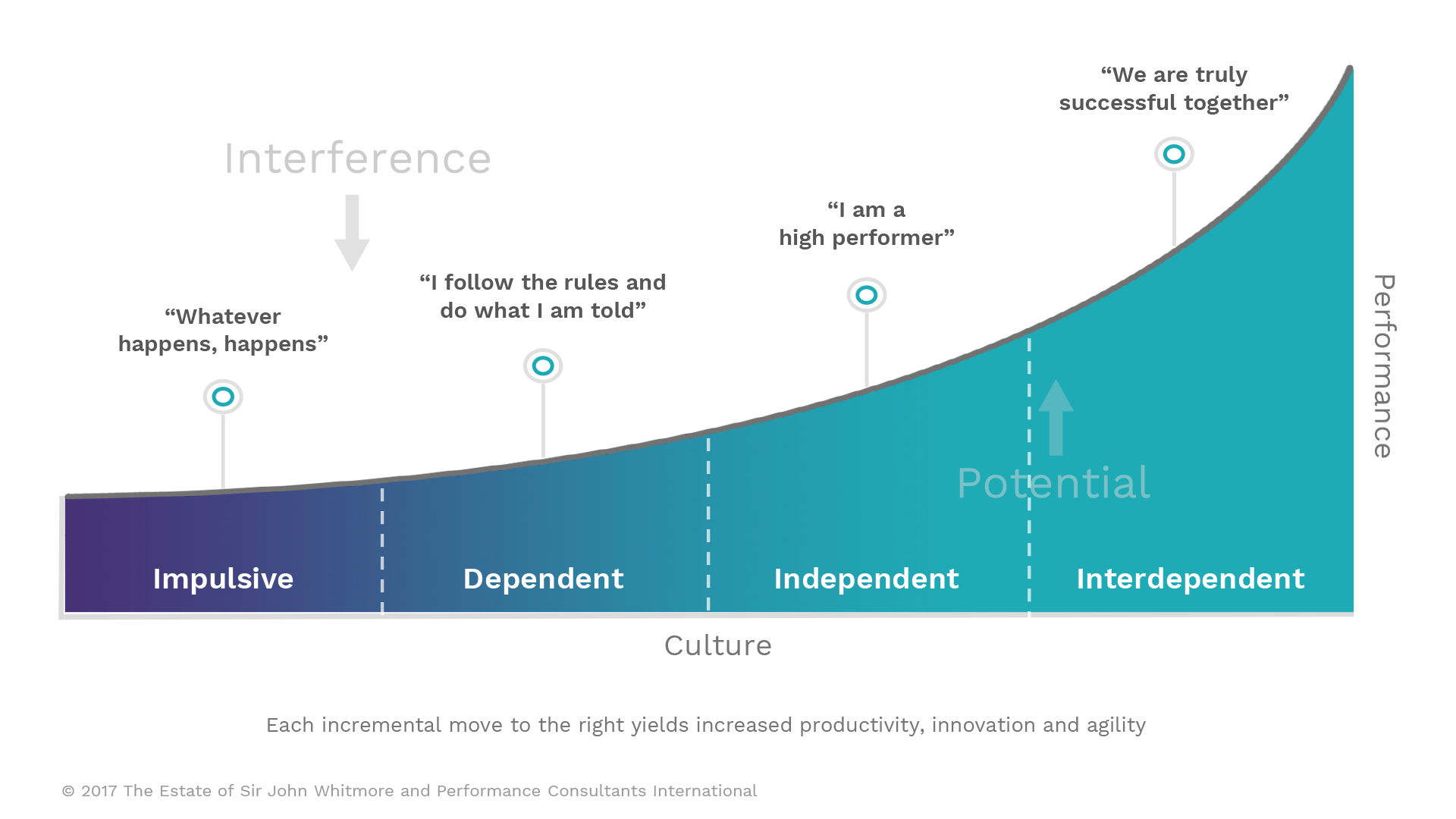
Early in my career I joined a huge global organization in the oil and gas sector. Its culture was very much in the Dependent zone as illustrated by The Performance Curve.
When our MD Tiffany Gaskell polled the audience at the recent Corporate L&D Summit in Barcelona, she found that most of the delegates also identified their organizational culture as Dependent. I found this curious, not least because my personal experience was about a decade ago. It doesn’t seem much has changed.
The stickiness of Dependent cultures can be attributed to a number of factors. For me, the most prevalent, and arguably the most deeply ingrained in our society, is how we are educated. The excellent Ken Robinson Ted Talk ‘Do Schools Kill Creativity?’ points out that a theme of the school system is that it conditions children to be compliant and to avoid taking risks.
GET COACHED BY THE WORLD’S TOP PERFORMANCE COACHES
Join one of our webinars to find out more about a coaching leadership style
In schools, compliance is rewarded with smiles and stars, non-compliance is punished with frowns and detention, innovation is not encouraged because it’s not in the curriculum. This is the reality for us (in the UK at least), from the ages of 4 to 16 – the most impressionable time of our lives. The respect for rule and order is important for a functioning society but it’s also creating a world where businesses are built on the same paradigms.
The upshot is that people in Dependent cultures are often waiting to be told what to do, managers see their role as command and control, and corporate politics abounds. Of course, it’s a complex issue but our experience is that mindsets such as these, stifle engagement, innovation and ultimately dampen an organization’s potential.
If you’re reading this you are on our website, so you’re probably aware that coaching might have a part to play in tackling this trickiest of challenges. Shifting an organization along The Performance Curve requires a systemic change, leaders that are able to lead a transformation and walk-the-talk. It’s also not just about a single enlightened leader asking good questions, empowering and developing their team, it needs to happen all at once, in one big push.
My point is really, a simple one. If you’re looking to change your organization’s culture, don’t go in softly. Think broader than a single Level 1 coaching programme for your executive team, consider how the feeling and the environment will change to foster the mindsets and behaviours of Interdependence.
If you would like to talk about how your organization could move up the curve, please get in touch.
Discover more
- Coaching Certification
- Coaching culture
- Coaching for Safety Performance
- Coaching leadership style
- Coaching management style
- Employee engagement
- Executive and Team Coaching
- GROW Coaching Model
- Leadership Development
- Leadership development
- Online
- Performance Coach Certification
- Performance Coach Module 1
- Performance Coach Module 2
- Performance Coach Module 3
- Performance Coach Module 5
- Safety Coaching
- Transformational Leader
- Transformational Leader Module 1
- Transformational Leader Module 2
- Transformational Leader Module 3
If you enjoyed this article, you may like to read next:
Connect with us:
How can you bring coaching into your organization?
Sir John and his colleagues at Performance Consultants were the first to take coaching into the workplace and coined the term “performance coaching” in the early 1980s. We continue to lead the field in performance improvement through coaching leadership training.
Select one of the options shown. Or get in touch and one of our world-class leadership development consultants will work with you to create a tailored programme that meets your specific needs.
- Attend a Coaching Course – experience the benefits of coaching first hand. See our Global Training Calendar to find the right course for you
- Transformational Leader Pathway – learn how to be a leader–coach with a coaching leadership style that creates a culture of high performance for you, your team and entire organization
- Performance Coach Certification – become a coach or take your coaching skills to the next level so that you can practise transformational leadership coaching
- Individual Coaching (1:1) – take your leadership to the next level with a tailored, fast-track professional development coaching programme
- Team Development – unlock the next level of potential in your team with team coaching

Discover why a coaching style of leadership is important to a millennial workforce
– 3 mins read –
The latest research into the millennial workforce* shows business has some way to go to achieve its potential for positive social impact. More than three quarters of millennials believe business should be a force for good on issues such as economic and social progress, conflict, inequality and corruption but, according to the research, big business is only meeting these expectations for 59 per cent of under-35 year olds.
The survey also shows that, after a year of global instability, millennials are less likely to want to leave the security of their jobs than previously, providing a huge opportunity for employers to engage. With many millennials now emerging leaders, holding senior management positions and managing people and teams, they have the opportunity to effect change in the workplace with huge potential gains for business if this potential can be successfully realized.
A coaching style of leadership strengthens purpose and performance
The search for meaning and purpose at work is not restricted to the millennial generation. With older workers also motivated by a sense of higher purpose, organizations are discovering how a coaching style of leadership nurtures high-performing, collaborative teams focused on a shared vision that will enable the organization to achieve its purpose.
In Coaching for Performance, Sir John Whitmore and his team at Performance Consultants explain how a coaching style of leadership creates the conditions for high performance. The 25th Anniversary Edition of Sir John’s bestselling book presents The Performance Curve (see figure below), a model that maps the culture of an organization and relates this to the conditions for low, medium or high performance. The Performance Curve enhances understanding of how a coaching culture is a high-performance culture, enabling a collaborative workforce with shared values to flourish.
COACHING TRAINING FOR LEADERS CREATED BY SIR JOHN WHITMORE
The latest findings from the International Coach Federation (ICF) and Human Capital Institute (HCI), Building a Coaching Culture with Millennial Leaders, shows how emerging leaders benefit from partnering with a coach and receiving training on how to use coaching skills with their peers and teams, while leaders at all ages want to develop a coaching style of leadership.
COACHING MINDSET The leader believes that the coachee is capable, resourceful, and full of potential. Believing in the dormant capability of a person will build their self-belief and self-motivation and enable them to flourish. And with that mindset, you can coach them to make their own powerful choices and find enjoyment in their performance and their success.
Extract from the Glossary of Coaching Terms, Coaching for Performance, Fifth Edition
According to the ICF and HCI’s report, the most effective leaders are those with the quality of emotional intelligence who use a collaborative coaching style of management. The research finds that organizations are looking to expand the scope of leaders using coaching skills, and highlights the business case for building a strong coaching culture:
- Respondents whose organizations had strong coaching cultures reported that 61 per cent of their employees are highly engaged, compared to 53 per cent from organizations without strong coaching cultures.
- Forty-six per cent of respondents in organizations with strong coaching cultures reported above-average 2016 revenue growth in relation to industry peers, versus 39 per cent of respondents from all other organizations.
A coaching style of leadership is about partnership, collaboration and believing in potential. It is leading for others rather than for oneself. With more organizations providing individual coaching (1:1 coaching) for the millennial generation and training them to develop their own coaching style, business really does have the potential to be a force for positive change and the opportunity to build a high-performing workforce motivated by a strong sense of higher purpose and the knowledge that the work they do matters.
*Deloitte Millennial Survey 2017, based on the views of almost 8,000 millennials (college or university graduates in full-time employment and born after 1982) in 30 countries in September 2016.
Register for our free Coaching for Performance webinar
to find out more about a coaching leadership style
For more information on 1:1 leadership coaching, coaching skills training for managers and leaders and our Coaching for Performance: Leadership Programme, please contact James Neville.
‘The Leader as Coach’, Harvard Business Review, November–December 2019
Discover more
- Coaching Certification
- Coaching culture
- Coaching for Safety Performance
- Coaching leadership style
- Coaching management style
- Employee engagement
- Executive and Team Coaching
- GROW Coaching Model
- Leadership Development
- Leadership development
- Online
- Performance Coach Certification
- Performance Coach Module 1
- Performance Coach Module 2
- Performance Coach Module 3
- Performance Coach Module 5
- Safety Coaching
- Transformational Leader
- Transformational Leader Module 1
- Transformational Leader Module 2
- Transformational Leader Module 3
If you enjoyed this article, you may like to read next:
Connect with us:
How can you bring a coaching leadership style into your organization?
Sir John and his colleagues at Performance Consultants were the first to take coaching into the workplace and coined the term “performance coaching” in the early 1980s. We continue to lead the field in performance improvement through coaching leadership training.
Select one of the options shown. Or get in touch and one of our world-class leadership development consultants will work with you to create a tailored programme that meets your specific needs.
- Attend a Coaching Course – experience the benefits of coaching first hand. See our Global Training Calendar to find the right course for you
- Transformational Leader Pathway – learn how to be a leader–coach with a coaching leadership style that creates a culture of high performance for you, your team and entire organization
- Performance Coach Certification – become a coach or take your coaching skills to the next level so that you can practise transformational leadership coaching
- Individual Coaching (1:1) – take your leadership to the next level with a tailored, fast-track professional development coaching programme
- Team Development – unlock the next level of potential in your team with team coaching
David Brown explains how transformational leaders create high-performance cultures.
– 5 mins read –
David Brown is CEO of Performance Consultants International, the company he co-founded with Sir John Whitmore, the father of coaching in the workplace. David has been instrumental in shaping the global performance, leadership and coaching industry for over 20 years. He was awarded the rarely bestowed Igniting Social Progress Award by the ICF Foundation in recognition of the global impact of his vision for raising performance in the workplace, and his belief in the power of individuals and organizations to create a better future.
What your grandmother could teach your organization
I invite you to think of a person you loved being with when you were young. Not a parent but perhaps a teacher, grandparent, friend of the family or other adult who positively influenced you. If I ask you to remember how you felt when you were with that person, the chances are that you’ll recall feeling listened to, that you had their full attention. You would say that although you were young this older person believed in you and treated you as an equal, and if they challenged you it was with trust and respect. To quote Maya Angelou:
We’ve run this exercise all over the world and we’ve found people everywhere have broadly the same response. And the result is they felt their potential to be limitless.
This is what high emotional intelligence feels like. It’s the ability to relate to others from a paradigm of trust rather than fear. How does this compare to the leaders in your organization? If you are one of those leaders, how do you measure up?
COACHING TRAINING FOR LEADERS CREATED BY SIR JOHN WHITMORE
“I’ve learned that people will forget what you said, people will forget what you did, but people will never forget how you made them feel.”
Maya Angelou
Leaders set the tone
In organizations, the leaders set the tone for everybody else. Studies by the Hay Group have shown they are the greatest influence on an organization’s culture and bottom-line performance, which they can affect by as much as 30%! Meanwhile, according to The Conference Board CEO Challenge:
“the cultural DNA of an organization is critical to success, from operational efficiency to better customer service, to greater talent attraction and retention, to higher levels of business performance and breakthroughs in innovation.”
So it seems crazy how very few organizations take a proactive approach to creating and measuring their culture.
Register for our free Coaching for Performance webinar
to find out more about a coaching leadership style
The Performance Curve
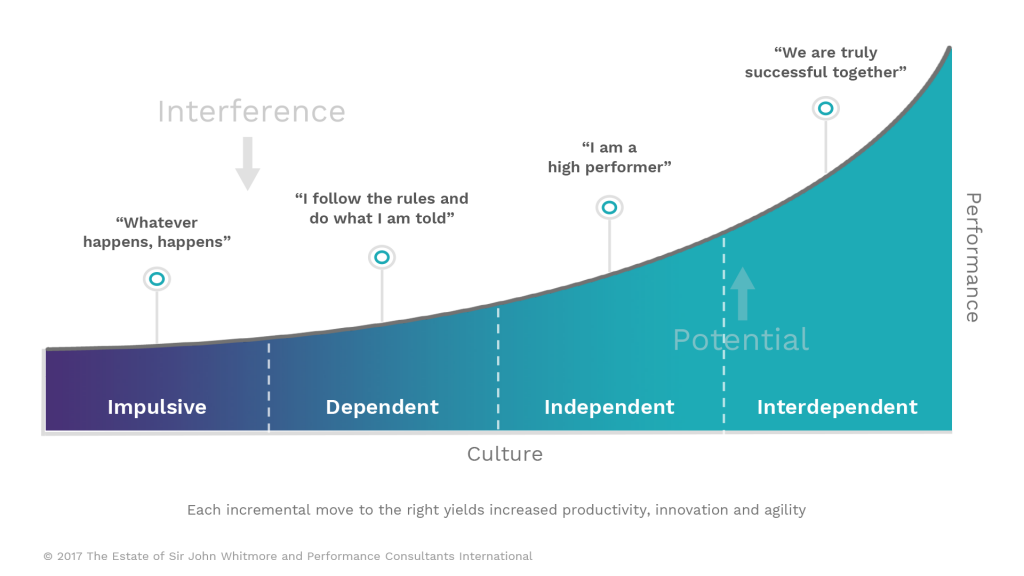
The Performance Curve focuses on the collective prevailing mindset of the culture and how this creates the conditions for performance. It provides a useful tool for organizations or individuals to gain an immediate idea of where they are operating, either from the perspective of “this is the culture of my organization” or “this is the culture I create”. Of course, different parts of an organization can operate on different parts of the curve! You can use this awareness, to see what needs to change in order to improve performance.
The leader who is emotionally intelligent will create a high-performance culture through their way of being. A high-performance culture is often described as a “collective mentality” where there is a strong community spirit and collaboration around a shared sense of purpose. This interdependent culture, where people are able to grow and fulfil their potential, is the most highly evolved as seen on The Performance Curve.
If you’re very lucky you may have experienced this culture, but the chances are greater that you are more familiar with the other prevailing mindsets identified by The Performance Curve: impulsive; dependent; independent; inter-dependent. Each of these stages follows the process of individual psychological development which sees a reactive, short-term “Whatever happens, happens” way of being (impulsive) progress through dependence and “following the rules”, typified by behaviours such as judgement and blame, to independence which can be high-performing but carries the risks that it is too individualist. The ultimate stage is interdependence, a collective mentality supported by the leader I have described.
There are challenges to changing culture, even if there is a clear view of the benefits of a more mature and evolved state. It can push people out of their comfort zone, especially as giving people trust and ownership can feel like losing power for leaders, however they soon find they get this back in multiple from a team that is empowered and responsible and operating in a more agile way that is responsive to customers.
Coaching is bigger than coaching
A coaching style of leadership is the enabler for a high-performance culture because it shifts the organizational mindset to interdependence.
As Stephen Covey said in The Seven Habits of Highly Effective People:
Something your grandmother or that wise older person knew all along.
“Whether you are the president of the company or the janitor, the moment you step from independence into interdependence in any capacity, you step into a leadership role.”
Stephen Covey
“Chapter 2: Creating High-performance Cultures”, Coaching for Performance, Sir John Whitmore and Performance Consultants
Discover more
- Coaching Certification
- Coaching culture
- Coaching for Safety Performance
- Coaching leadership style
- Coaching management style
- Employee engagement
- Executive and Team Coaching
- GROW Coaching Model
- Leadership Development
- Leadership development
- Online
- Performance Coach Certification
- Performance Coach Module 1
- Performance Coach Module 2
- Performance Coach Module 3
- Performance Coach Module 5
- Safety Coaching
- Transformational Leader
- Transformational Leader Module 1
- Transformational Leader Module 2
- Transformational Leader Module 3
If you enjoyed this article, you may like to read next:
Connect with us:
How can you create a high-performance culture in your organization?
Sir John and his colleagues at Performance Consultants were the first to take coaching into the workplace and coined the term “performance coaching” in the early 1980s. We continue to lead the field in performance improvement through coaching leadership training.
Select one of the options shown. Or get in touch and one of our world-class leadership development consultants will work with you to create a tailored programme that meets your specific needs.
- Attend a Coaching Course – experience the benefits of coaching first hand. See our Global Training Calendar to find the right course for you
- Transformational Leader Pathway – learn how to be a leader–coach with a coaching leadership style that creates a culture of high performance for you, your team and entire organization
- Performance Coach Certification – become a coach or take your coaching skills to the next level so that you can practise transformational leadership coaching
- Individual Coaching (1:1) – take your leadership to the next level with a tailored, fast-track professional development coaching programme
- Team Development – unlock the next level of potential in your team with team coaching
Discover how to face up to the cultural challenge, and how organizations are risking their future.
– 5 mins read –
Observing the speed with which an organization of Kodak’s history and calibre is overtaken by disruptive innovation, and reading research by Innosight that estimates “three-quarters of today’s S&P 500 will be replaced by 2027″ (reported by @HBR), it’s no wonder big organizations are scrambling for answers to these new threats.
I was reflecting on this after speaking at the Corporate L&D Summit hosted by Luxatia International – a great opportunity to connect with fellow senior professionals to share ideas and concerns.
I was reflecting on this after speaking at the Corporate L&D Summit hosted by Luxatia International – a great opportunity to connect with fellow senior professionals to share ideas and concerns.
GET COACHED BY THE WORLD’S TOP PERFORMANCE COACHES
Join one of our webinars to find out more about a coaching leadership style
I talked about The Performance Curve which we use to measure company culture and bottom-line performance. It maps culture states from Impulsive to Interdependent, showing how the quality of interactions between leaders and their direct reports releases untapped potential, in the right-hand quadrant. Our experience working with leaders using a coaching style of management, as pioneered by Sir John Whitmore, has shown how this can be achieved.
When I took the opportunity to poll the audience to gauge where delegates felt their organizations were on The Performance Curve, the vast majority of people in the room felt that their companies had a Dependent Culture. This tends to be characterized by a “command and control” paradigm. Dependent Cultures are typically the second phase of organizational maturity where the introduction of processes and systems to curtail inconsistency and mitigate risk, simultaneously stifle innovation and autonomy with employees expected to “follow the rules.”
While there is a rational justification for a Dependent Culture, the risks of limiting employee performance and organizational progress are obvious.
Change needs to come from the top down however, conventional leadership mindsets are the key challenge for today’s organizations – a view echoed in the conversations that took place at last week’s Summit.
Enabling leaders to empower their teams can only happen by shifting mindsets, which is where we see the power of Coaching for Performance. The motivation has to be intrinsic and systemic; meaning everyone, from the CEO to the new hire, recognizes the power of coaching practices in unleashing potential for both people and organizations.
It’s frequently neglected but an essential part of all transformations whether these are Agile, Digital or Innovation. The alternative for organizations is a slow decline and eventual irrelevance in a market where change is accelerating and disruption is constant.
If you’re looking to improve your business culture and performance, or would like a copy of my presentation, get in touch – [email protected].
Finally, I highly recommend Luxatia International’s Corporate L&D Summit. The quality of content and conversations was exceptional and the event provided a refreshing mix of interactive presentations, exercises and case studies.
The author Tiffany Gaskell is Performance Consultants’ Global Director of Coaching and Leadership.
Discover more
- Coaching Certification
- Coaching culture
- Coaching for Safety Performance
- Coaching leadership style
- Coaching management style
- Employee engagement
- Executive and Team Coaching
- GROW Coaching Model
- Leadership Development
- Leadership development
- Online
- Performance Coach Certification
- Performance Coach Module 1
- Performance Coach Module 2
- Performance Coach Module 3
- Performance Coach Module 5
- Safety Coaching
- Transformational Leader
- Transformational Leader Module 1
- Transformational Leader Module 2
- Transformational Leader Module 3
If you enjoyed this article, you may like to read next:
Connect with us:
How can you bring coaching into your organization?
Sir John and his colleagues at Performance Consultants were the first to take coaching into the workplace and coined the term “performance coaching” in the early 1980s. We continue to lead the field in performance improvement through coaching leadership training.
Select one of the options shown. Or get in touch and one of our world-class leadership development consultants will work with you to create a tailored programme that meets your specific needs.
- Attend a Coaching Course – experience the benefits of coaching first hand. See our Global Training Calendar to find the right course for you
- Transformational Leader Pathway – learn how to be a leader–coach with a coaching leadership style that creates a culture of high performance for you, your team and entire organization
- Performance Coach Certification – become a coach or take your coaching skills to the next level so that you can practise transformational leadership coaching
- Individual Coaching (1:1) – take your leadership to the next level with a tailored, fast-track professional development coaching programme
- Team Development – unlock the next level of potential in your team with team coaching

Tiffany Gaskell describes the most powerful way of investing in learning and development to create transformational leaders and maximize productivity in a fast-moving world.
– 8 mins read –
Most people think of “coaching” as 1:1 executive coaching which focuses on helping key leaders to achieve high performance, but what if a coaching culture could enable everyone to perform at their peak?
The latest research shows over 80% of organizations use coaching and believe in its benefits.1 However, there is still a broad lack of understanding of what coaching is and how to use coaching to maximize results – another recent study found that only 30% of people surveyed actually understood what coaching was.2 Even those organizations already embarked on creating a coaching culture acknowledge the opportunities for development are huge, with growing awareness of the different types of coaching and most effective applications.3
Among the growing awareness and interest in coaching, organizations are missing a trick. It is well-known that the greatest influencers of an organization’s culture are its leaders: studies show that leadership behaviour impacts bottom-line performance by up to 30 per cent.4 External executive coaching is rightly seen as one of the most effective forms of leadership development,5 with many organizations choosing to invest in it, however helping leaders to develop a coaching leadership style is overlooked.
COACHING FOR PERFORMANCE
TRANSFORMATIONAL LEADER PATHWAY
“It is a weight off my shoulders, my team is more self-sufficient.”
“People come up with solutions that are wildly different. And they have full ownership and are acting with commitment.”
“They figure out through the process what they want to do and then have the excitement and energy for next steps.”
In-house Coaching for Performance participants
Join one of our webinars to find out how to become a transformational leader
What is transformational leadership?
A “transformational leader” is a leader who can engage and inspire by using transformational soft skills that create high performance in themselves, their teams and their whole organization. Transformational leaders are the leaders of tomorrow and will enable their teams and whole organizations to rise to the complexity and multiple challenges of today’s business world.
If, instead of coaching an individual leader to improve their own performance, coaching skills are leveraged to create a transformational leadership style and taught to leaders, the organization will achieve a maximum return on their investment in coaching.
According to the recent survey by the Leadership Institute at the London Business School, today’s leaders find themselves fire-fighting and unable to spend time on strategy and planning. In such an environment, leaders need to be supported to break the pattern and, instead of solving problems for others, develop others to solve their own problems. Leaders who are able to do this will find themselves freed from fire-fighting to attend to those overarching strategic opportunities where they can make a difference.
“If leaders manage by the principles of coaching, they get the job done to a higher standard and develop their people simultaneously. It sounds too good to be true to have 250 days a year of getting the job done and 250 days a year of employee development per person, but that is precisely what a coaching leader does get.”
Sir John Whitmore, Co-Founder, Performance Consultants
Transformational leaders achieve a triple win
A leader leveraging coaching skills to create a high performance culture creates 250 development days per year for employees:
It is clear that transformational leaders achieve a triple win. The leader develops themself and gains the skills to develop their teams; groups of leaders from the same organization undergo the same leadership development, focused on finding their personal connection to leadership. This creates a shared language which they take with them into the workplace. They in turn develop others. This is what we mean by transformational leaders.
The return on investment is significant, with transformational leaders reporting an average 800% ROI. For one cohort of 17 leaders, this represented US$1,245,000 which came from improvements in bottom-line profitability and cost reductions. One participant reported that by delegating more and trusting in his team, the culture of the team had strengthened. This in turn impacted productivity which he estimated to have improved by at least 10% or US$350,000 per year.
Leaders with coaching skills create a high-performance culture
With organizations typically missing out on approximately 60% of the talent available to them,6 a coaching leadership style enables leaders and organizations to harness the full potential of their employees by inspiring and engaging them in a way that shifts the relationship and moves the culture to one of high performance. To help leaders and organizations reflect on the culture being created in their organization, we developed The Performance Curve model which we published in Coaching for Performance, Fifth Edition. The four stages of The Performance Curve are described by our CEO David Brown in his thoughts on Creating the Conditions for High Performance.
By leveraging coaching skills to create a high-performance culture that is led by transformational leaders, the investment in coaching benefits everybody, not only the few, and organization most of all.
Never has this new leadership been more relevant with leaders and organizations challenged to evolve by society, including employees who want to find fulfilment and purpose in their work. Equally, customers demand that companies act with integrity. Meeting these extended demands requires leaders today to be able to inspire and engage, with results that are truly transformational.
TRANSFORMATIONAL LEADERSHIP COURSE | TRANSFORMATION AWARENESS FOR LEADERS AND COACHES
The author Tiffany Gaskell is Performance Consultants’ Global Director of Coaching and Leadership.
1 Leadership Institute, London Business School (2017) Leadership Survey 2017 – Navigating Uncertainty: Global leadership challenges, London Business School.
2 The International Coach Federation (ICF) 2017 Global Consumer Awareness Study showed consumers struggle to differentiate between coaching, consulting, mentoring, counselling etc. 66% indicated they were aware of professional business and/or life coaching, however when presented with definitions for five personal and organizational support professions only 30% understood what coaching is, many getting it confused with mentoring.
3 Mann, Clive (2016) 6th Ridler Report: Strategic trends in the use of coaching, Ridler & Co.
4 Hay Group and others.
5 Leadership Institute, London Business School (2017) Leadership Survey 2017 – Navigating Uncertainty: Global leadership challenges, London Business School.
6 Research by Performance Consultants International.
Transformation webinar: mindset training for transformational change
An introduction to the Iceberg Coaching Model and Level 2 of our Transformational Leader Pathway
Creating the conditions for high performance
Discover more
- Coaching Certification
- Coaching culture
- Coaching for Safety Performance
- Coaching leadership style
- Coaching management style
- Employee engagement
- Executive and Team Coaching
- GROW Coaching Model
- Leadership Development
- Leadership development
- Online
- Performance Coach Certification
- Performance Coach Module 1
- Performance Coach Module 2
- Performance Coach Module 3
- Performance Coach Module 5
- Safety Coaching
- Transformational Leader
- Transformational Leader Module 1
- Transformational Leader Module 2
- Transformational Leader Module 3
If you enjoyed this article, you may like to read next:
Connect with us:
How can you develop transformational leadership in your organization?
Sir John and his colleagues at Performance Consultants were the first to take coaching into the workplace and coined the term “performance coaching” in the early 1980s. We continue to lead the field in performance improvement through coaching leadership training.
Select one of the options shown. Or get in touch and one of our world-class leadership development consultants will work with you to create a tailored transformation programme that meets your specific needs.
- Attend a Coaching Course – experience the benefits of coaching first hand. See our Global Training Calendar to find the right course for you
- Transformational Leader Pathway – learn how to be a leader–coach with a coaching leadership style that creates a culture of high performance for you, your team and entire organization
- Performance Coach Certification – become a coach or take your coaching skills to the next level so that you can practise transformational leadership coaching
- Individual Coaching (1:1) – take your leadership to the next level with a tailored, fast-track professional development coaching programme
- Team Development – unlock the next level of potential in your team with team coaching
Discover how to develop millennial leaders.
– 5 mins read –
Generation Y, the millennials – those born between 1983 and 2000 – are often characterized as tolerant and socially conscious, but also overconfident and entitled. In reality they represent the next stage in our human evolution. They believe businesses should provide fulfilment of purpose, innovation, work-life balance and solutions to the world’s biggest problems. From a 2014 Deloitte survey in which they interviewed 7,800 millennials from 26 countries, it turns out that 75 per cent also believe their organizations could do more to develop future leaders. To find out how we help Brandwatch – the fast-growing social media monitoring company – develop its millennial leaders, see below.
Leadership is changing. Now that almost everyone in the organization has access to the same information, and can process it just as fast, it’s more about setting direction than being the ‘front of all knowledge’. In fact, the younger, tech-savvy employees seem to process information even faster. The question now has become whether they believe in the leader’s direction, and their pace. The Deloitte study also shows that one in four millennials are asking for a chance to show their leadership skills, which points to the next step in corporate evolution: devolved responsibility.
So how do companies maintain the commitment of this tech-savvy, sometimes even described as narcissistic, generation? Employers need to give millennials more opportunity to develop personally and professionally. And, as reported in the survey, if businesses fail to address these concerns, they risk losing skilled professionals in the years ahead as many of the most talented millennials decide to leave large organizations and work for themselves – roughly 70 per cent of these millennials see themselves working independently at some point.
GET COACHED BY THE WORLD’S TOP PERFORMANCE COACHES
Join one of our webinars to find out more about a coaching leadership style
Google, always perceived to be at cutting edge of innovation and top of the world’s ideal-employer ranking for today’s young talent, has run Project Oxygen to research the attributes of its best managers. After extensive research, it came up with 8 Rules on How to Be a Good Boss. We are delighted to see that Be A Good Coach tops the list. It is clear that these Generation Y professionals need – and want – to learn how to lead, not just from a technical skills perspective but also from an interpersonal perspective.
“One of the biggest missing pieces in the corporate world globally is adequate grooming and development of pipeline talent for succession into the most senior roles. This keeps on coming up in research as one of the most pressing strategic issues for CEOs and companies.”
John Collingwood, Director Global Organization Development, Medtronic
Creating a Coaching Culture at Millennials Employer, Brandwatch

The good news is that Being a Good Coach can be learned. Performance Consultants International is working with the social intelligence software company, Brandwatch, based out of Brighton, UK, with offices in the US and Germany. This Silicon Alley venture is growing very rapidly and has decided to create a supportive and empowering culture to manage the productivity and wellbeing of their existing employees and new hires.
Sebastian Hempstead, EVP The Americas, a forward thinking young leader, chose us after an extensive search for the right coach training company. He wanted to add coaching skills to his management and leadership style with the aim of being a better coach to his teams. After he attended our public course Coaching for Performance, Level 1, in New York with two of his colleagues, each at a different managerial level of the organization, the company decided that this learning should be distributed throughout the organization, which employs mostly millennials. They took advantage of the Corporate Discount Card described below to send additional managers to the Level 1 public course in London and New York. The aim is for them to learn coaching skills to create a coaching culture throughout the company.
“Company culture is very important at Brandwatch. We see ourselves as an innovative, creative, and honest company. We have built an employee roster of brilliant individuals that encompasses all of that. By emphasizing coaching as a managerial strategy, we’re investing in our own team,”
Hempstead
Corporate Discount Card: Flexibility and Cost Savings on Public Courses
The Corporate Discount Card allows companies to receive a substantial group discount for training their managers and leaders without having to organize an in-house group event. Instead, by buying bulk attendance on any of our public courses, the client will not only receive a significant per-head discount but will also be able to choose which of our global public workshops each manager attends and when. This flexibility allows attendees to choose the time and place that best fits their location and schedule, and also means that employees can split up and decide whether or not to be in the same workshops as their managers or direct reports.
If you would like to know more about our Corporate Discount Card, or any of our other coach training and leadership development services, please email our Chief Operating Officer James Neville or call him on +44 (0)20 3903 0011. He will be delighted to talk to you.
Discover more
- Coaching Certification
- Coaching culture
- Coaching for Safety Performance
- Coaching leadership style
- Coaching management style
- Employee engagement
- Executive and Team Coaching
- GROW Coaching Model
- Leadership Development
- Leadership development
- Online
- Performance Coach Certification
- Performance Coach Module 1
- Performance Coach Module 2
- Performance Coach Module 3
- Performance Coach Module 5
- Safety Coaching
- Transformational Leader
- Transformational Leader Module 1
- Transformational Leader Module 2
- Transformational Leader Module 3
If you enjoyed this article, you may like to read next:
Connect with us:
How can you bring coaching into your organization?
Sir John and his colleagues at Performance Consultants were the first to take coaching into the workplace and coined the term “performance coaching” in the early 1980s. We continue to lead the field in performance improvement through coaching leadership training.
Select one of the options shown. Or get in touch and one of our world-class leadership development consultants will work with you to create a tailored programme that meets your specific needs.
- Attend a Coaching Course – experience the benefits of coaching first hand. See our Global Training Calendar to find the right course for you
- Transformational Leader Pathway – learn how to be a leader–coach with a coaching leadership style that creates a culture of high performance for you, your team and entire organization
- Performance Coach Certification – become a coach or take your coaching skills to the next level so that you can practise transformational leadership coaching
- Individual Coaching (1:1) – take your leadership to the next level with a tailored, fast-track professional development coaching programme
- Team Development – unlock the next level of potential in your team with team coaching

Discover coaching as a management style.
– 3 mins read –
Join our free webinar on the Application of Coaching as a Management Style led by Jon Williams, Senior Consultant at Performance Consultants, who has over 20 years’ experience of building a coaching culture in a leading bank. On this call, you will learn simple and effective tools that you can incorporate into the way you carry out your role as a manager which will radically improve your performance and also that of your teams.
As our Chairman Sir John Whitmore liked to remind us:
“Coaching is much bigger than coaching!”
Sir John Whitmore
Coaching for Performance around the world
Are you interested in reaching your full potential and enabling your team and organization to reach theirs? Or are you looking to become a certified coach? Performance Consultants have the right solution for you delivered through our highly acclaimed public courses which we host across the world.
If you have a group of people who want training, all programmes are available in-house, and can also be customized for your organization. To learn more, please contact our CEO David Brown at [email protected].
GET COACHED BY THE WORLD’S TOP PERFORMANCE COACHES
Join one of our webinars to find out more about a coaching leadership style
CIPD London: Have your cake … Eat your car!
We had lots of fun at the CIPD Learning & Development Show in London explaining why we had a fabulous bright yellow racing car cake on our stand.

In the business world, Sir John Whitmore (shown here with his ‘car-cake’ at our CIPD stand) is best known for the GROW Model, his work on leadership development and book Coaching for Performance which is now the No. 1 Best Seller on Amazon.co.uk in three categories: Management; Business team management skills; and Business coaching & mentoring skills.
In the world of sports, Sir John is a racing legend. In fact it’s not so long ago that Olympia London hosted an entirely different event at which a 1965 Ford Lotus Cortina driven by Formula 1 World Champion Jim Clark and Sir John sold at auction. And early in his racing career, Sir John achieved his dream of racing at Le Mans, competing in a Ford GT40 with Innes Ireland.
A slice of chocolate cake disguised as the bright yellow McLaren M8F Sir John drove to victory in his 1990 racing comeback is not all that people wanted from us at the CIPD show. Companies also were keen to find out how Performance Consultants could work with them on leadership development, performance improvement and organizational transformation, based on our 30 years of experience working with individuals and companies around the world.
Management coaching tip: Developing a coaching mindset
When you go to work tomorrow, try incorporating the three fundamentals of a coaching mindset:
- Look for potential, not problems
- Acknowledge progress and success
- Don’t criticize or blame
Write down at the end of the day what you learned and what the impact was. Keep this up for 40 days, and you will have started to develop a new coaching management style.

Discover more
- Coaching Certification
- Coaching culture
- Coaching for Safety Performance
- Coaching leadership style
- Coaching management style
- Employee engagement
- Executive and Team Coaching
- GROW Coaching Model
- Leadership Development
- Leadership development
- Online
- Performance Coach Certification
- Performance Coach Module 1
- Performance Coach Module 2
- Performance Coach Module 3
- Performance Coach Module 5
- Safety Coaching
- Transformational Leader
- Transformational Leader Module 1
- Transformational Leader Module 2
- Transformational Leader Module 3
If you enjoyed this article, you may like to read next:
Connect with us:
How can you bring coaching into your organization?
Sir John and his colleagues at Performance Consultants were the first to take coaching into the workplace and coined the term “performance coaching” in the early 1980s. We continue to lead the field in performance improvement through coaching leadership training.
Select one of the options shown. Or get in touch and one of our world-class leadership development consultants will work with you to create a tailored programme that meets your specific needs.
- Attend a Coaching Course – experience the benefits of coaching first hand. See our Global Training Calendar to find the right course for you
- Transformational Leader Pathway – learn how to be a leader–coach with a coaching leadership style that creates a culture of high performance for you, your team and entire organization
- Performance Coach Certification – become a coach or take your coaching skills to the next level so that you can practise transformational leadership coaching
- Individual Coaching (1:1) – take your leadership to the next level with a tailored, fast-track professional development coaching programme
- Team Development – unlock the next level of potential in your team with team coaching