
Mid-Year Conversations: From Box-Ticking to Breakthrough
What a Leader Coach style looks like inside a real mid-year conversation – and why the shift from judgement to curiosity changes everything.
Most mid-year conversations carry more than they should. Six months of unsaid things. Patterns that were never quite named. Moments that passed without being addressed. By the time June arrives, the conversation is trying to hold all of it – and that weight is exactly what makes it feel so difficult to get right.
The gap between what a good mid-year conversation could be and what it tends to look like in practice has less to do with intent than with skill. Specifically, the skill of raising awareness without delivering a verdict.
Describe, don’t judge
There is a meaningful difference between “I’ve noticed some issues with how you work with the team” and “I noticed you stepped in before Kevin had finished. What did you notice in that moment?”
The first statement invites defensiveness. The second offers a specific, observable fact and then hands the conversation over. One closes things down. The other opens them up.
Sir John Whitmore, founder of Performance Consultants and co-creator of the GROW model with others, held that once you raise awareness, people take responsibility. Descriptive communication is how awareness gets raised. The less a leader labels or concludes, the clearer the picture of reality becomes – and the more the coachee owns what comes next.
The solutions people commit to are the ones they find themselves
When a leader resists the urge to advise, something shifts. The person in the conversation stops waiting to hear what they should do and starts working out what they actually want to do. Those two things produce very different outcomes.
This is the core of the Leader Coach style: not coaching instead of managing, but integrating a coaching approach into the real work of leadership – including the non-negotiables, the difficult feedback and the conversations that have been waiting too long.
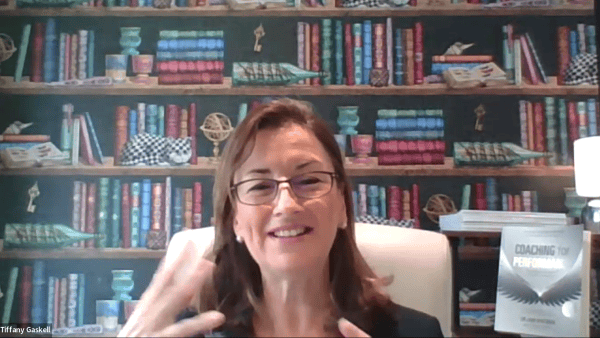
On 21 May, Performance Consultants CEO Tiffany Gaskell demonstrated this live in a fireside chat with Senior Consultant Barbara Dewast. Watch the full recording here.
In the demonstration, Tiffany named a specific behavior – a team member cutting across a colleague in a meeting – and then handed the conversation over. No advice. No verdict. By the end, the coachee had identified her own pattern, worked out her own strategy and committed to a re-contracting conversation with her team. The solutions came from her. That is why they will stick.
Nothing at mid-year should come as a surprise
If something is worth raising in June, it was worth raising when it happened.
The conversations that are hardest at mid-year are almost always the ones carrying accumulated difficulty. Addressing things as they arise – from a grounded place, with curiosity – is what builds the kind of relationship where a mid-year conversation becomes a genuine check-in rather than a reckoning.
The mindset shift that makes this possible is preparation that goes beyond content. Before a high-stakes conversation, the question worth sitting with is: if this meeting were to wildly exceed my expectations, what would that look like? Using this as a starting point changes how a leader walks into the room – and the person across from them can feel the difference.
Download the Mid-Year Conversations Success Map
The three moves that work in the room, how to approach a closed mindset, and the questions that tend to open things up – all captured in a practical one-page resource.
Keep building this
If you’re thinking about how to build these capabilities across a team or organization, we’d be glad to have that conversation. Contact Us