
Discover the leader qualities needed for a modern CEO.
– 5 mins read –
What leader qualities do we ask of a 21st century CEO? The Harvard Business Review (HBR) has just issued an article entitled ‘What Leadership Looks Like in Different Cultures’. The article, authored by Tomas Chamorro-Premuzic and Michael Sanger, considers what makes a great leader and focuses on how cultures react to different leadership styles: for example, passive-aggressive leaders are more widely accepted in Indonesia and Malaysia.
With all of the differences, are there similar traits that are desirable?
GET COACHED BY THE WORLD’S TOP PERFORMANCE COACHES
Join one of our webinars to find out more about a coaching leadership style
Our experience of working with successful leaders shows that they are able to connect with their people at a deeper level. Leaders should have the ability to transform the way employees think and feel, how they behave and respond to challenges, expand their team members’ potential, raise accountability and create powerful shifts in corporate perspective, performance and possibility. Where humility might once have been perceived as weakness in a leader, employees today welcome it as a sign of strong leadership. And they want their leader to be authentic. Alongside this, leader qualities such as courage and adaptability are essential within a changing business landscape that requires rapid responses to global challenges.
Coaching is very much related to how we live in the world – the coaching approach is, in essence, a way of being. In our work to help senior leaders develop the best leadership style, while we are building competencies, in the end we are working with human beings and they should not be taken as just a productive entity. Instead, we work with them to foster the understanding of what is going on inside of themselves, enabling them to become aware of their own self and the world. So that in turn, they envision what they can do for their people as a leader, and they develop the necessary leader qualities to make it possible.
- Read more about the work we do on transformational leadership and creating a coaching leadership style.
Discover more
- Coaching certification
- Coaching culture
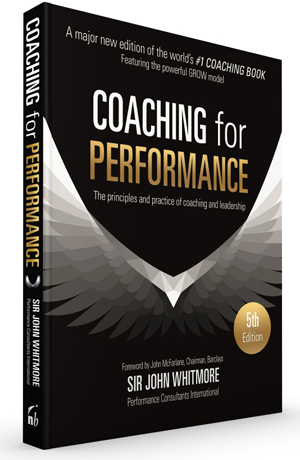
- Coaching for Performance
- Coaching for Safety
- Coaching leadership style
- Coaching management style
- Coaching training
- Employee engagement
- Featured
- GROW Coaching Model
- Leadership development
- Online
- Performance Coach Certification
- Performance Coach Module 1
- Performance Coach Module 2
- Performance Coach Module 3
- Performance Coach Module 4
- Performance Coach Module 6
- Transformational Leader
- Transformational Leader Module 1
- Transformational Leader Module 2
- Transformational Leader Module 3
If you enjoyed this article, you may like to read next:
Connect with us:
How can you bring coaching into your organization?
Sir John and his colleagues at Performance Consultants were the first to take coaching into the workplace and coined the term “performance coaching” in the early 1980s. We continue to lead the field in performance improvement through coaching leadership training.
Select one of the options shown. Or get in touch and one of our world-class leadership development consultants will work with you to create a tailored programme that meets your specific needs.
- Attend a Coaching Course – experience the benefits of coaching first hand. See our Global Training Calendar to find the right course for you
- Transformational Leader Pathway – learn how to be a leader–coach with a coaching leadership style that creates a culture of high performance for you, your team and entire organization
- Performance Coach Certification – become a coach or take your coaching skills to the next level so that you can practise transformational leadership coaching
- Individual Coaching (1:1) – take your leadership to the next level with a tailored, fast-track professional development coaching programme
- Team Development – unlock the next level of potential in your team with team coaching
Discover how culture eats strategy for breakfast.
– 5 mins read –
It is too often true that “culture eats strategy for breakfast”, so how do we actually create a culture that will help our people deliver and strengthen company strategy?
According to a 2007 survey conducted by the management consulting firm Bain & Company, worldwide business leaders identified corporate culture to be critical for business success. The mobile technology company Ericsson, for example, has understood that for continued performance its culture needs to be adaptive and agile.
To help them on their way, our Global Director of Coaching & Leadership, Tiffany Gaskell, recently delivered a keynote at Ericsson’s Innovation Conference in Madrid. Marta San Martin, their Agile Driver and Coach, underscored the importance of culture by saying “continuous evolution and innovation is essential in our business in every aspect, including culture”.
“Has encouraged me to look more deeply at myself and to understand what I am capable of.”
Chris Wade, Head of Strategy, Acquisitions and Partnerships, Sage Pay, UK – participant at Coaching for Performance, Level 2, London, October 2014
in Madrid. Marta San Martin their Agile Driver and Coach, underscored the importance of culture by saying “continuous evolution and innovation is essential in our business in every aspect, including culture”.
Why not start off the new year by creating the culture you need to perform?
In this month’s newsletter, we share the secret to creating your own winning culture that you can put into practice right away.
GET COACHED BY THE WORLD’S TOP PERFORMANCE COACHES

Join one of our webinars to find out more about a coaching leadership style
Create Your Own Winning Culture
We always knew strategy was important but how many companies proactively create their own winning culture? We can all influence and create the culture we need to perform. Follow these three simple steps to Create Your Own Winning Culture. You can do this in a company, a team or as an individual:
Step 1: The Secret
The secret is “awareness”. When we become aware of something, we have choice about it. So by simply becoming aware of what you want for your own winning culture and what the reality of your existing culture is, you will have a choice to do something about it.
We define culture as “the way things are done around here” – an unwritten system of shared approaches and of similar behaviours.
To learn more about your culture, do the following exercise:
The below graph sets out the four main types of culture. We all need different levels of support and challenge. Take a moment to think about your current working environment.

- Choose a spot on the graph that describes what your current culture is. Jot down the characteristics of your current culture.
- Now choose a spot on the graph that represents what you would like your culture to be that would best support your performance. Jot down how it would be different and any similarities with your current culture.
Step 2: Responsibility
To explore the different relationships we have with culture, we invite you to watch this video:
Now ask yourself what relationship you tend to have with culture – pick the ones that could describe you (you can pick as many as you like):
Are you like the frog put in boiling water who can immediately recognize if the culture isn’t a fit for you and so you jump out?
Are you like the frog in slowly heating water who allows the temperature to rise to uncomfortable levels?
Are you not like the frog in the video and able to know and ask for what you need, ie get out and turn the temperature to what you need to perform well?
Which did you choose?
A: Generally we are quite good at spotting A – it is something so alien or unsupportive of our performance that we jump out. Think of a company that you didn’t join. Or perhaps even a project that you tried to do but failed.
B: Most often, like the frog in B, we allow ourselves to become unconsciously absorbed by culture. The water might be a little too hot or cold for us to perform well, but we make do and get on with things. However, what we need to keep in mind is that, at the same time as being influenced by culture, we are also influencing culture and we can use our influence to create the culture we want.
C: This is the challenge of the 21st Century in organizations – proactively managing culture so that it empowers people. You can choose to do this yourself and create your own winning culture – once you are aware of what you need, you can ask for what you need and set the water temperature just right to perform well.
Step 3: Action
Now you know what you would like your culture to be:
- Make a list of at least three things that will help you get from where you are now, to where you want to be.
- Now pick one thing from your list and take steps to complete it.
- Notice what changes and repeat until you have completed your list.
Conclusion
Creating your own winning culture marks the next step in the evolution of the relationship between companies and individuals. It’s not about top-down, hierarchical structures anymore; now it is about individual empowerment and responsibility. At Performance Consultants we focus on building the management and leadership skills to create winning cultures. Through our coaching and leadership development programmes, we provide individuals and companies with the tools, skills and insights to create cultures that not only support strategy but deliver more.
To create a winning culture in your organization, join one of our public courses:
Is Sir John Whitmore one of History’s Greatest Business Pioneers?
Over the next few weeks The Financial Times is asking people to nominate their top business pioneers of all time.
We think that Sir John Whitmore’s pioneering work in bringing a coaching style of management to world-class organizations puts him in the running. His work was the foundation for the birth and explosion of the coaching industry that we have seen globally and which is now helping business to transform from the inside out. His book Coaching for Performance has sold over a million copies in 23 languages, while his coaching programmes with innovative tools and techniques are now being delivered in 40 countries around the world. He has been at the vanguard of the paradigm change in management thinking and practice from heroic to post-heroic leadership where the focus is on people finding purpose and fulfilment in their work.
The FT article notes: “Their [pioneering leaders] achievements are seldom theirs alone”; this is absolutely at the heart of the coaching style of management which Sir John Whitmore has championed. We would love you to join us in nominating Sir John Whitmore as one of the top business pioneers by emailing [email protected] or tweeting at #FTPioneers. And please let the FT know why you are nominating our pioneering leader.
Discover more
- Coaching certification
- Coaching culture
- Coaching for Performance
- Coaching for Safety
- Coaching leadership style
- Coaching management style
- Coaching training
- Employee engagement
- Featured
- GROW Coaching Model
- Leadership development
- Online
- Performance Coach Certification
- Performance Coach Module 1
- Performance Coach Module 2
- Performance Coach Module 3
- Performance Coach Module 4
- Performance Coach Module 6
- Transformational Leader
- Transformational Leader Module 1
- Transformational Leader Module 2
- Transformational Leader Module 3
If you enjoyed this article, you may like to read next:
Connect with us:
How can you bring coaching into your organization?
Sir John and his colleagues at Performance Consultants were the first to take coaching into the workplace and coined the term “performance coaching” in the early 1980s. We continue to lead the field in performance improvement through coaching leadership training.
Select one of the options shown. Or get in touch and one of our world-class leadership development consultants will work with you to create a tailored programme that meets your specific needs.
- Attend a Coaching Course – experience the benefits of coaching first hand. See our Global Training Calendar to find the right course for you
- Transformational Leader Pathway – learn how to be a leader–coach with a coaching leadership style that creates a culture of high performance for you, your team and entire organization
- Performance Coach Certification – become a coach or take your coaching skills to the next level so that you can practise transformational leadership coaching
- Individual Coaching (1:1) – take your leadership to the next level with a tailored, fast-track professional development coaching programme
- Team Development – unlock the next level of potential in your team with team coaching
Discover how to develop millennial leaders.
– 5 mins read –
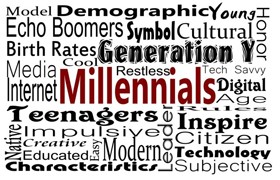
Generation Y, the millennials – those born between 1983 and 2000 – are often characterized as tolerant and socially conscious, but also overconfident and entitled. In reality they represent the next stage in our human evolution. They believe businesses should provide fulfilment of purpose, innovation, work-life balance and solutions to the world’s biggest problems. From a 2014 Deloitte survey in which they interviewed 7,800 millennials from 26 countries, it turns out that 75 per cent also believe their organizations could do more to develop future leaders. To find out how we help Brandwatch – the fast-growing social media monitoring company – develop its millennial leaders, see below.
Leadership is changing. Now that almost everyone in the organization has access to the same information, and can process it just as fast, it’s more about setting direction than being the ‘front of all knowledge’. In fact, the younger, tech-savvy employees seem to process information even faster. The question now has become whether they believe in the leader’s direction, and their pace. The Deloitte study also shows that one in four millennials are asking for a chance to show their leadership skills, which points to the next step in corporate evolution: devolved responsibility.
So how do companies maintain the commitment of this tech-savvy, sometimes even described as narcissistic, generation? Employers need to give millennials more opportunity to develop personally and professionally. And, as reported in the survey, if businesses fail to address these concerns, they risk losing skilled professionals in the years ahead as many of the most talented millennials decide to leave large organizations and work for themselves – roughly 70 per cent of these millennials see themselves working independently at some point.
GET COACHED BY THE WORLD’S TOP PERFORMANCE COACHES
Join one of our webinars to find out more about a coaching leadership style
Google, always perceived to be at cutting edge of innovation and top of the world’s ideal-employer ranking for today’s young talent, has run Project Oxygen to research the attributes of its best managers. After extensive research, it came up with 8 Rules on How to Be a Good Boss. We are delighted to see that Be A Good Coach tops the list. It is clear that these Generation Y professionals need – and want – to learn how to lead, not just from a technical skills perspective but also from an interpersonal perspective.
“One of the biggest missing pieces in the corporate world globally is adequate grooming and development of pipeline talent for succession into the most senior roles. This keeps on coming up in research as one of the most pressing strategic issues for CEOs and companies.”
John Collingwood, Director Global Organization Development, Medtronic
Creating a Coaching Culture at Millennials Employer, Brandwatch

The good news is that Being a Good Coach can be learned. Performance Consultants International is working with the social intelligence software company, Brandwatch, based out of Brighton, UK, with offices in the US and Germany. This Silicon Alley venture is growing very rapidly and has decided to create a supportive and empowering culture to manage the productivity and wellbeing of their existing employees and new hires.
Sebastian Hempstead, EVP The Americas, a forward thinking young leader, chose us after an extensive search for the right coach training company. He wanted to add coaching skills to his management and leadership style with the aim of being a better coach to his teams. After he attended our public course Coaching for Performance, Level 1, in New York with two of his colleagues, each at a different managerial level of the organization, the company decided that this learning should be distributed throughout the organization, which employs mostly millennials. They took advantage of the Corporate Discount Card described below to send additional managers to the Level 1 public course in London and New York. The aim is for them to learn coaching skills to create a coaching culture throughout the company.
“Company culture is very important at Brandwatch. We see ourselves as an innovative, creative, and honest company. We have built an employee roster of brilliant individuals that encompasses all of that. By emphasizing coaching as a managerial strategy, we’re investing in our own team,”
Hempstead
Corporate Discount Card: Flexibility and Cost Savings on Public Courses
The Corporate Discount Card allows companies to receive a substantial group discount for training their managers and leaders without having to organize an in-house group event. Instead, by buying bulk attendance on any of our public courses, the client will not only receive a significant per-head discount but will also be able to choose which of our global public workshops each manager attends and when. This flexibility allows attendees to choose the time and place that best fits their location and schedule, and also means that employees can split up and decide whether or not to be in the same workshops as their managers or direct reports.
If you would like to know more about our Corporate Discount Card, or any of our other coach training and leadership development services, please email our Chief Operating Officer James Neville or call him on +44 (0)20 3903 0011. He will be delighted to talk to you.
Discover more
- Coaching certification
- Coaching culture
- Coaching for Performance
- Coaching for Safety
- Coaching leadership style
- Coaching management style
- Coaching training
- Employee engagement
- Featured
- GROW Coaching Model
- Leadership development
- Online
- Performance Coach Certification
- Performance Coach Module 1
- Performance Coach Module 2
- Performance Coach Module 3
- Performance Coach Module 4
- Performance Coach Module 6
- Transformational Leader
- Transformational Leader Module 1
- Transformational Leader Module 2
- Transformational Leader Module 3
If you enjoyed this article, you may like to read next:
Connect with us:
How can you bring coaching into your organization?
Sir John and his colleagues at Performance Consultants were the first to take coaching into the workplace and coined the term “performance coaching” in the early 1980s. We continue to lead the field in performance improvement through coaching leadership training.
Select one of the options shown. Or get in touch and one of our world-class leadership development consultants will work with you to create a tailored programme that meets your specific needs.
- Attend a Coaching Course – experience the benefits of coaching first hand. See our Global Training Calendar to find the right course for you
- Transformational Leader Pathway – learn how to be a leader–coach with a coaching leadership style that creates a culture of high performance for you, your team and entire organization
- Performance Coach Certification – become a coach or take your coaching skills to the next level so that you can practise transformational leadership coaching
- Individual Coaching (1:1) – take your leadership to the next level with a tailored, fast-track professional development coaching programme
- Team Development – unlock the next level of potential in your team with team coaching

Discover coaching as a management style.
– 3 mins read –
Join our free webinar on the Application of Coaching as a Management Style led by Jon Williams, Senior Consultant at Performance Consultants, who has over 20 years’ experience of building a coaching culture in a leading bank. On this call, you will learn simple and effective tools that you can incorporate into the way you carry out your role as a manager which will radically improve your performance and also that of your teams.
As our Chairman Sir John Whitmore liked to remind us:
“Coaching is much bigger than coaching!”
Sir John Whitmore
Coaching for Performance around the world
Are you interested in reaching your full potential and enabling your team and organization to reach theirs? Or are you looking to become a certified coach? Performance Consultants have the right solution for you delivered through our highly acclaimed public courses which we host across the world.
If you have a group of people who want training, all programmes are available in-house, and can also be customized for your organization. To learn more, please contact our CEO David Brown at [email protected].
GET COACHED BY THE WORLD’S TOP PERFORMANCE COACHES
Join one of our webinars to find out more about a coaching leadership style
CIPD London: Have your cake … Eat your car!
We had lots of fun at the CIPD Learning & Development Show in London explaining why we had a fabulous bright yellow racing car cake on our stand.

In the business world, Sir John Whitmore (shown here with his ‘car-cake’ at our CIPD stand) is best known for the GROW Model, his work on leadership development and book Coaching for Performance which is now the No. 1 Best Seller on Amazon.co.uk in three categories: Management; Business team management skills; and Business coaching & mentoring skills.
In the world of sports, Sir John is a racing legend. In fact it’s not so long ago that Olympia London hosted an entirely different event at which a 1965 Ford Lotus Cortina driven by Formula 1 World Champion Jim Clark and Sir John sold at auction. And early in his racing career, Sir John achieved his dream of racing at Le Mans, competing in a Ford GT40 with Innes Ireland.
A slice of chocolate cake disguised as the bright yellow McLaren M8F Sir John drove to victory in his 1990 racing comeback is not all that people wanted from us at the CIPD show. Companies also were keen to find out how Performance Consultants could work with them on leadership development, performance improvement and organizational transformation, based on our 30 years of experience working with individuals and companies around the world.
Management coaching tip: Developing a coaching mindset
When you go to work tomorrow, try incorporating the three fundamentals of a coaching mindset:
- Look for potential, not problems
- Acknowledge progress and success
- Don’t criticize or blame
Write down at the end of the day what you learned and what the impact was. Keep this up for 40 days, and you will have started to develop a new coaching management style.

Discover more
- Coaching certification
- Coaching culture
- Coaching for Performance
- Coaching for Safety
- Coaching leadership style
- Coaching management style
- Coaching training
- Employee engagement
- Featured
- GROW Coaching Model
- Leadership development
- Online
- Performance Coach Certification
- Performance Coach Module 1
- Performance Coach Module 2
- Performance Coach Module 3
- Performance Coach Module 4
- Performance Coach Module 6
- Transformational Leader
- Transformational Leader Module 1
- Transformational Leader Module 2
- Transformational Leader Module 3
If you enjoyed this article, you may like to read next:
Connect with us:
How can you bring coaching into your organization?
Sir John and his colleagues at Performance Consultants were the first to take coaching into the workplace and coined the term “performance coaching” in the early 1980s. We continue to lead the field in performance improvement through coaching leadership training.
Select one of the options shown. Or get in touch and one of our world-class leadership development consultants will work with you to create a tailored programme that meets your specific needs.
- Attend a Coaching Course – experience the benefits of coaching first hand. See our Global Training Calendar to find the right course for you
- Transformational Leader Pathway – learn how to be a leader–coach with a coaching leadership style that creates a culture of high performance for you, your team and entire organization
- Performance Coach Certification – become a coach or take your coaching skills to the next level so that you can practise transformational leadership coaching
- Individual Coaching (1:1) – take your leadership to the next level with a tailored, fast-track professional development coaching programme
- Team Development – unlock the next level of potential in your team with team coaching